Hermione von Preuschen (1854 – 1918)
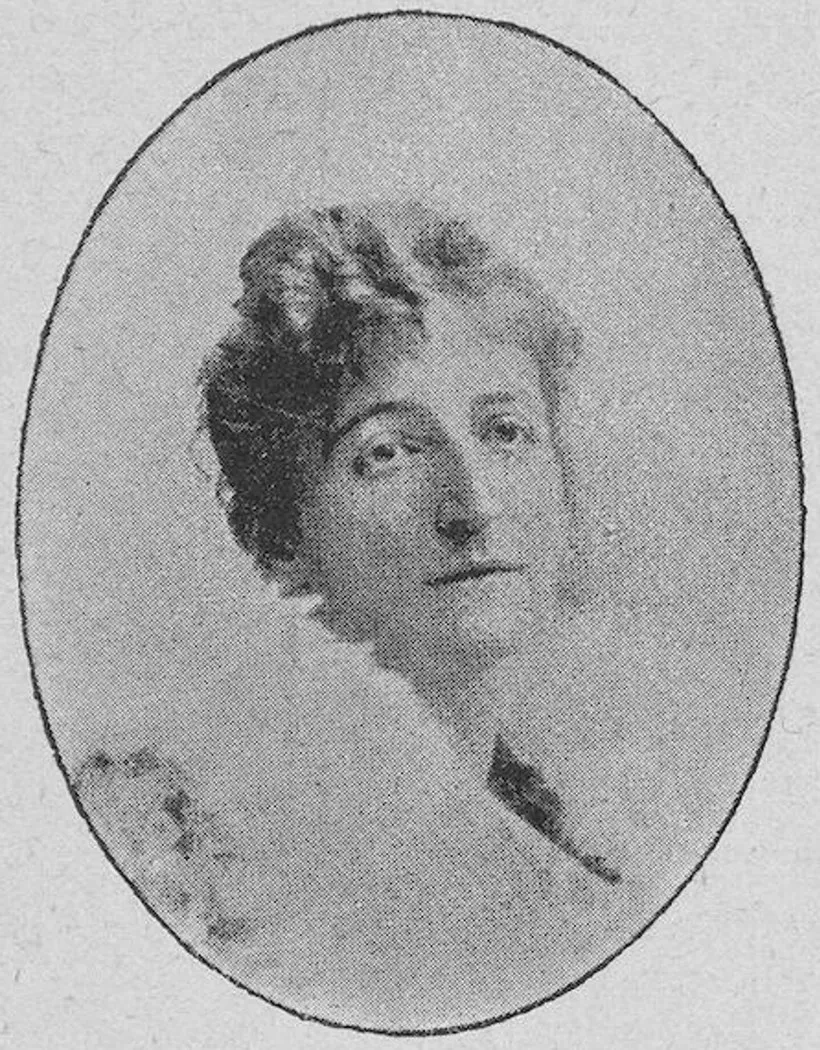
Hermione von Preuschen was a German painter, poet, and world traveler — a Symbolist who painted death and decay on a grand scale, a working woman artist in a field that barely tolerated her, and an outspoken advocate for women’s emancipation. She is well remembered in German art history and almost invisible in English, which is exactly what this project sets out to correct.
Early life and training
Born on 7 August 1854 in Darmstadt into a well-connected family (her father was a privy councillor), she had the means to travel and to paint without depending on sales. In the early 1870s she trained at the Academy in Karlsruhe under Ferdinand Keller (and Hans Gude), absorbing his decorative, dramatic manner. She first made her name in historical still life — lavish, symbol-laden arrangements of flowers, fruit, and objects — and lived for years in Rome, exhibiting there and in Turin.
Mors Imperator (1887) — the scandal
Her most famous painting shows Death as an emperor: a crowned skeleton in an ermine-lined purple robe, standing on the globe, leaning on a sword and overturning a throne as a jeweled crown falls. The Berlin Art Exhibition jury rejected it in 1887, reading it as an allusion to the 90-year-old Kaiser Wilhelm I (who died the next year) — dangerously close to lèse-majesté.
Instead of retreating, the 33-year-old rented rooms at Leipziger Straße 43 and exhibited the “banned” painting herself, for an admission fee. Crowds came, the press argued, and the scandal made her famous overnight. A neutral English witness, The Art Journal of London, confirmed a few years later that the picture — “after being rejected by the Berlin Exhibition Jury, drew a large paying public in the exhibitions of the principal cities of Germany and Austria.” (See The Paper Trail.)
Writer, and Rilke’s admiration
She was a prolific author as well as a painter, moving in literary circles that included Theodor Storm, Paul Heyse, and Rainer Maria Rilke — who, reviewing her in 1896, wrote that “she paints her magnificent poems… is the poem a picture or the picture a poem?” She poured the same allegorical imagination into verse and prose: poetry collections, novellas, travel writing, and finally a novel and a memoir. See her Works, with their English translations.
Marriages, travels, and later life
She married twice on her own terms — to the Munich physician Oswald Schmidt (1882, divorced 1890), then to the writer Konrad Telmann (1891; he died in Rome in January 1897), with whom she had two daughters. She traveled relentlessly: a journey through India, Ceylon, and Burma (1905–06) fed her travel book, and around 1909–10 she toured the United States (New York and Chicago), giving a sardonic press interview and gathering material for a planned book on America.
She had exhibited internationally. In 1893 a painting of hers hung in the Rotunda of the Woman’s Building at the World’s Columbian Exposition in Chicago — the building’s showpiece hall — where an American survey singled it out: “Frau Von Preuschen’s ‘Elaine’ represents the lily maid of Astolat lying in her flower-strewn barge.” That volume also reproduced the picture, which is why we can still see it; the painting itself has since dropped out of sight. It was not, in fact, a Tennyson subject at all: her own title was Irene von Spilimberg auf der Totengondel, and the dead woman in the barge is Preuschen herself, painted from a life-size photograph of herself laid out as a corpse. See Elaine. A still life of hers entered the British Royal Collection. She died in 1918 in Berlin-Lichtenrade, at the Tempio Hermione, a temple-like villa she had built and named for herself, and was buried in the Protestant Cemetery in Rome beside Telmann.
Rediscovery
Largely dropped from the standard English-language canon, she is being reclaimed: the Alte Nationalgalerie in Berlin mounted “Scandal! Hermione von Preuschen and the Mors Imperator” (22 March – 15 November 2026), bringing the painting back into public view for the first time in generations.
This biography cites contemporary sources gathered under The Paper Trail. Facts here are drawn from her own memoir Der Roman meines Lebens (1926), period English press, and current museum scholarship.