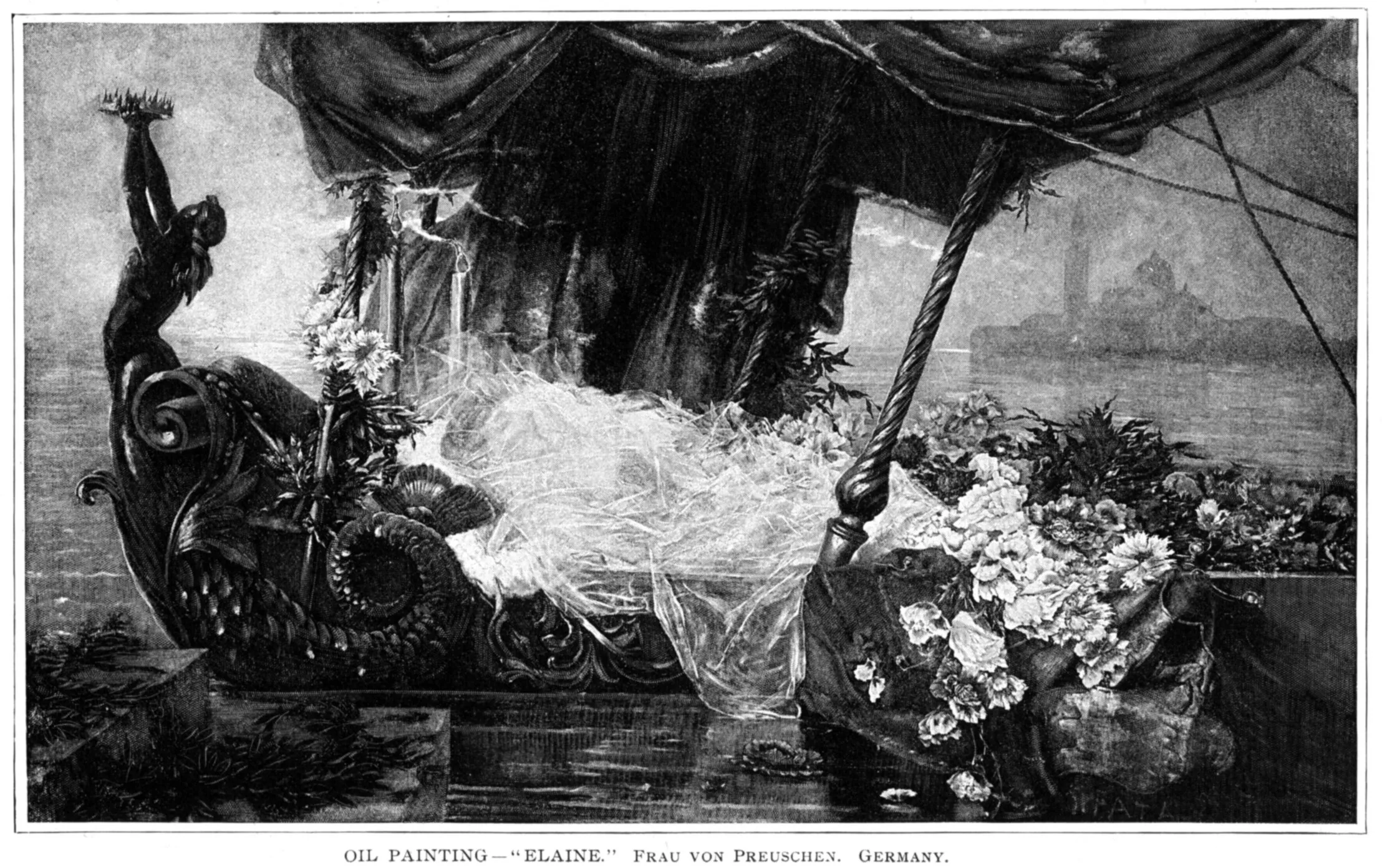
Elaine
This is the work an American survey singled out at the Woman’s Building of the 1893 World’s Columbian Exposition in Chicago, where it hung in the Rotunda, the building’s showpiece hall: “Frau Von Preuschen’s ‘Elaine’ represents the lily maid of Astolat lying in her flower-strewn barge.” Proof her reputation reached across the Atlantic in her lifetime. She is absent from the catalogue of the Fine Arts Palace; the Woman’s Building was her Chicago.
But Elaine is not what she called it, and the Tennyson reading is not what she painted.
Her own title, and her own face
The setting was always the giveaway. Tennyson’s Elaine drifts down a river to Camelot — but this barge has a carved and gilded prow, a black funeral canopy, and a domed city standing on the water behind it. That is Venice. K. L. Nichols’s survey of the 1893 women exhibitors records the Rotunda picture under a quite different title: Titian’s Pupil and Irene von Spilimberg in the Gondola of Death.
Her memoir settles it. In chapter 10 she names the picture herself — »Irene von Spilimberg auf der Totengondel« — and says what it shows: the lying-in-state of Irene di Spilimbergo (1538–1559), the Friulian noblewoman said to have been Titian’s pupil, who died at twenty-one, laid out on the Piazzetta and garlanded with flowers by the people of Venice. She had carried the subject for about fifteen years: the poet Joseph Victor von Scheffel told her Irene’s story over Sunday lunch in Karlsruhe when she was a student, as the novel he meant to write and never did.
Then the part no one could have guessed from the plate:
Following a bizarre whim, I decided to give Irene my own features. She was, after all, a painter and a poet like me. Blonde and blue-eyed into the bargain. I had myself photographed life-size as a corpse. I still possess the picture.
So the body under the gauze is Preuschen herself — a self-portrait as a dead woman, painted from a life-size photograph of herself laid out as a corpse, by a painter who had just made her name and lost her friendships with Mors Imperator, Death crowned and enthroned. She still had the photograph when she wrote her memoir, in the last years of her life; the book was published only in 1926, after her death. The photograph has not been traced.
About this image
What you see is not a photograph of the painting but a halftone plate from the 1893 Exposition volume — Maud Howe Elliott’s Art and Handicraft in the Woman’s Building (Rand, McNally & Co., 1894), facing p. 46, captioned OIL PAINTING — “ELAINE.” FRAU VON PREUSCHEN. GERMANY. It is the only known image of the picture. The painting’s present whereabouts are uncertain; German Wikipedia places a work of this title in the Musées de Metz, unverified.
The title it is catalogued under here is the one the plate carries, since that is how the picture has been known for 130 years. Elaine is best understood as what an English-speaking fair made of a Venetian death-picture — Tennyson’s lily maid, dead of unrequited love in her flower-strewn barge, was so thoroughly familiar to Anglo-American taste that the substitution would have needed no explaining. Whether Preuschen made it herself, to sell the picture to Chicago, or whether the fair made it for her, is not yet known.
