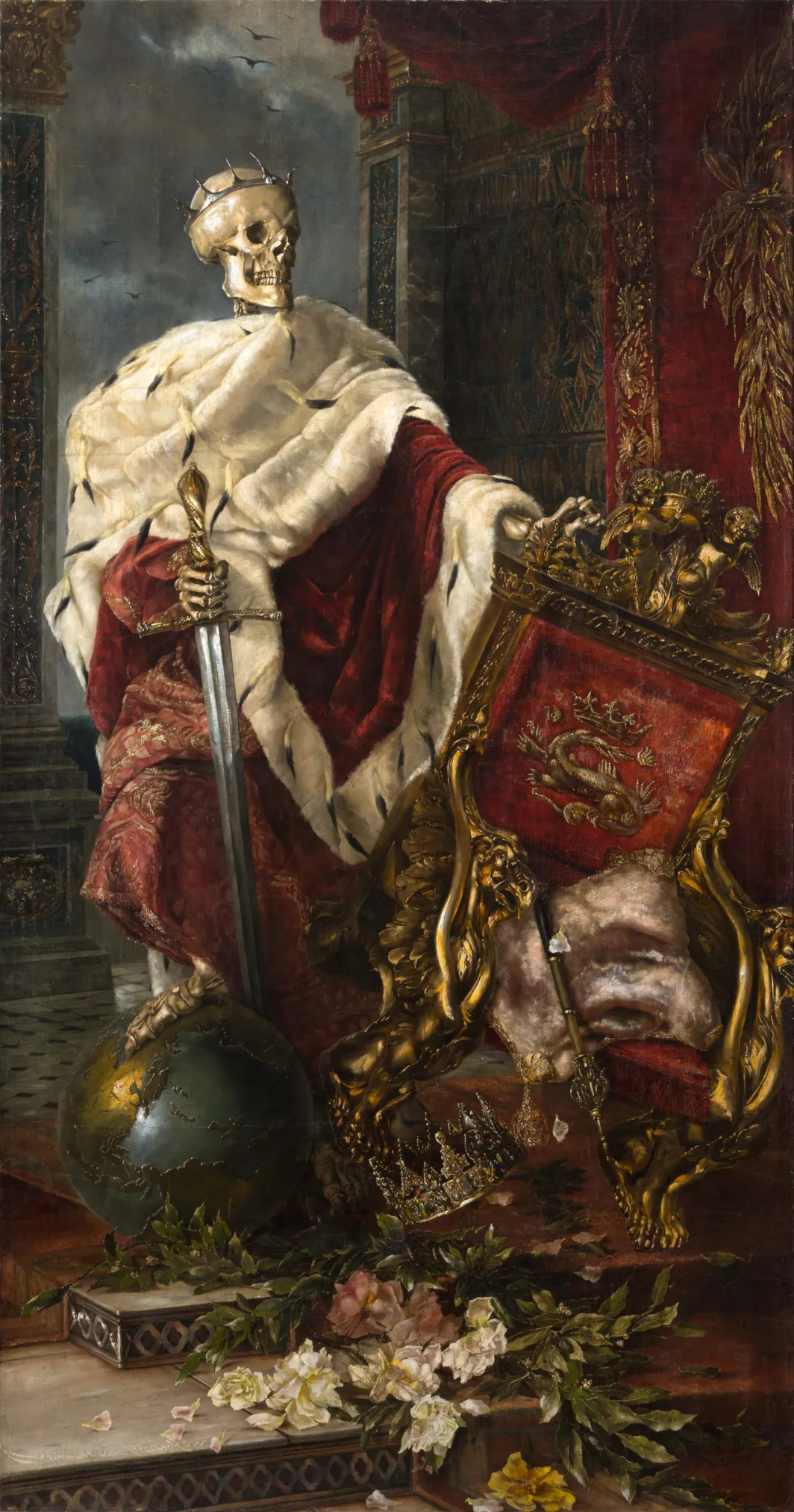
Mors Imperator
Her most famous work. A crowned skeleton — Death as sovereign — stands in an ermine-lined purple robe and iron crown, one foot on the globe, leaning on a sword and overturning a throne as a jeweled crown tumbles to the floor: a memento mori that no earthly power outlasts death.
The Berlin Art Exhibition jury rejected it in 1887, fearing it alluded to the 90-year-old Kaiser Wilhelm I. Preuschen rented her own rooms on Leipziger Straße and exhibited the “banned” painting for an admission fee; the scandal made her famous. It returned to public view in the Alte Nationalgalerie’s 2026 exhibition.
How big it is. The reports from the 2026 exhibition give it as 2.5 by 1.3 metres (The Guardian, 21 March 2026) and 2.60 by 1.30 (rbb radio3, 23 March 2026). Every figure from her own time is larger: Boetticher’s catalogue of her work (Malerwerke des neunzehnten Jahrhunderts, 1898) gives 3.50 m high and 1.50 m wide, and the papers of 1887 guessed anything from 3 × 2½ m to 4¼ m high and 2 m wide.
The affair, in documents
The rejection is the best-documented episode of her life, and this site holds it from several sides. In the order the pieces were written:
- Her open letter, August 1887 — she answered the jury in several Berlin papers on 5 and 6 August, the Kreuzzeitung among them, and Austria reprinted it. The earliest piece of her own prose the project holds, and the first time she took a case over an institution’s head.
- The Kunst-Chronik’s report — a Viennese art paper following the contradictory rulings day by day. The soberest account of what actually happened, and the one that admits nobody could establish what the Kaiser wanted.
- The Kikeriki satire — anonymous Viennese verse taking her side within days: the jury allows Makart’s nudes and bans her naked truth.
- The Art Journal, London, 1890 — a studio visit three years on, and an outside witness to what the rejection did for her. The picture, “after being rejected by the Berlin Exhibition Jury, drew a large paying public in the exhibitions of the principal cities of Germany and Austria.”
- Salt Lake City, 1910 — twenty-three years later and an ocean away, a local paper still dates her fame to this canvas.
Two of her own books turn on it as well:
- Chapter 10 of her memoir — her own account, written thirty years afterwards: the title she nearly used instead, the year she spent at the easel, and the sentence she says the president of the Academy used to refuse it — “the crooked execution of a crooked thought.” Her open letter of 1887 tells it differently: there he told her the subject alone was the ground, and the “crooked thought” is in the statement he published in reply, dated 6 August 1887.
- Noch einmal „Mors Imperator“ — the elegy of 1897 for her husband Konrad Telmann, which takes the painting’s title back for a real death.
The biography sets the episode in the shape of her life, and she was still calling herself an outsider “through Mors Imperator” in the last chapters of the memoir, thirty years on.
