At the Gate of the Future
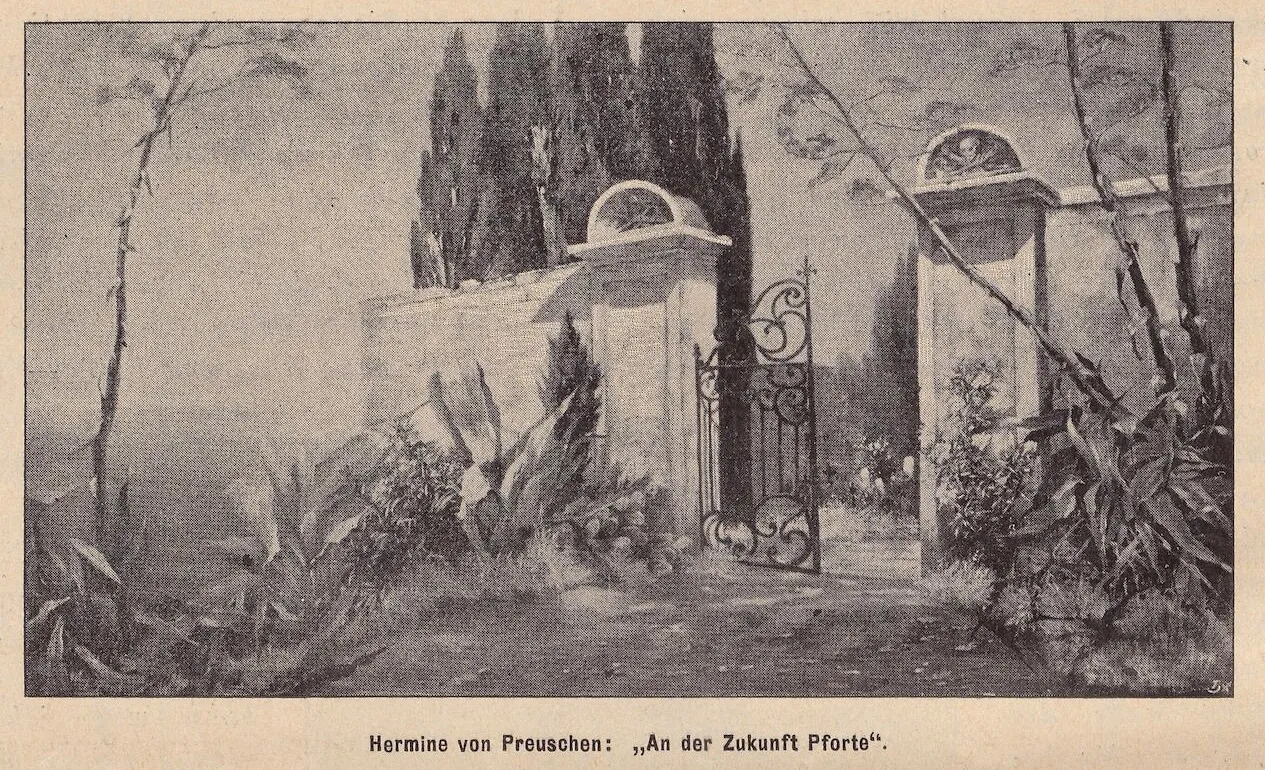
A cemetery gate, standing half open. Wrought-iron scrollwork hangs between rendered piers with carved lunettes above them; cypresses stand black behind the wall; agaves and aloes shoulder in from both sides, and a path runs away through the gap into light.
The title makes the reading explicit — the gate of the future is the gate of a graveyard — and the picture belongs with the symbolist thread that runs from Mors Imperator through The Life-Sphinx.
Friedrich von Boetticher’s Malerwerke des neunzehnten Jahrhunderts (“Painters’ Works of the Nineteenth Century”, 1898) lists it as no. 43 of her pictures and describes it: „Das von Agaven umwucherte Gittertor eines auf felsiger Höhe gelegenen Friedhofs, an dessen Füssen das blaue Meer” — “the agave-overgrown iron gate of a cemetery on a rocky height, with the blue sea at its foot”. He records it as one of four pictures she showed at Gurlitt’s gallery in Berlin in January 1894. The plate reproduced here, printed in the Berlin art-trade journal Im Künstlerland on 25 May 1895, matches that description and gives the picture a face. It had already been on show in Munich: a letter from there of 11 September 1893 describes, without naming it, a picture of hers at the Kunstverein — a stylised gate and ornate grille opening on a cemetery, prickly cacti by the wall, the sea in the distance — which matches this plate (Hamburger Fremdenblatt, 15 September 1893).
The painting is untraced. The reproduction is coarse — a magazine halftone at the size the page allowed — and it is the only image there is.