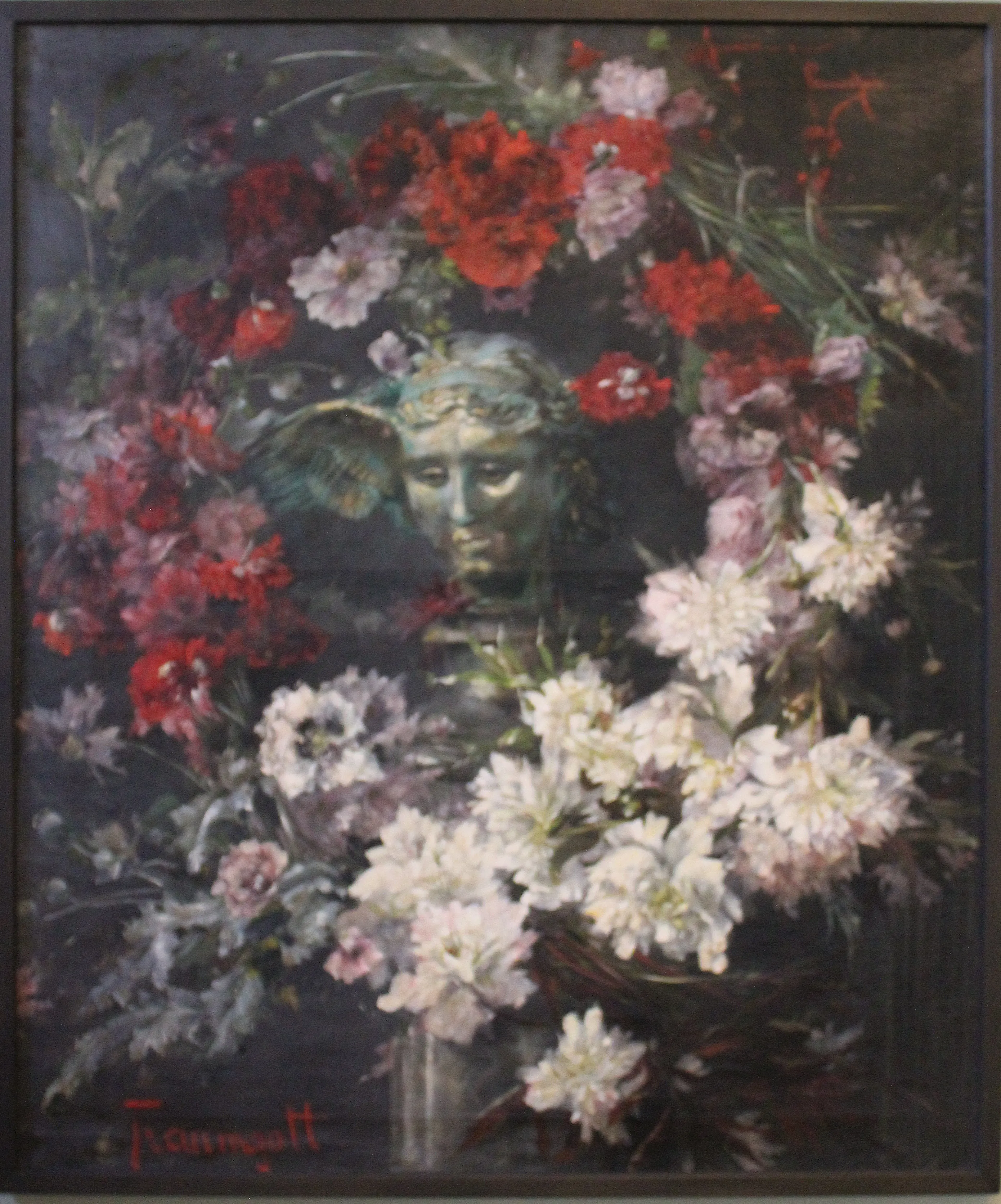
Traumgott
A weathered head of a winged god — the greenish cast of old bronze, eyes lowered as if asleep — set into a thicket of carnations and peonies that crowd in from every side. She signed it, in red, with the title itself: Traumgott, the god of dreams.
This is the manner the press was already calling historical still life in 1881 (Kölnische Zeitung, 10 October 1881), and that she made her own: flowers painted with a botanist’s attention, arranged around an object charged with myth, so that the genre most available to a nineteenth-century woman painter — the flower piece — becomes a vehicle for something far less domestic. The blooms are not a bouquet. They are a covering, heaped over a sleeping god the way Elaine’s flowers are heaped over a corpse.
It hangs in the Kunstmuseum Moritzburg in Halle — one of the few Preuschen paintings that stayed in a public collection rather than vanishing into private hands. A picture of hers in which “a mighty wreath” of passion flowers and poppies rings “a bronze bust of the dream god” was on show in her exhibition in Rome by December 1893 (Hannoverscher Kurier, 22 December 1893). That it is this canvas is likely but not proven: the review gives no title, and it names passion flowers and poppies where this page sees carnations and peonies. The first record that names it is of 1894: Boetticher’s catalogue of her work (1898) lists Traumgott at the Great Berlin Art Exhibition of that year.
